Early days: switching on neurons with a laser
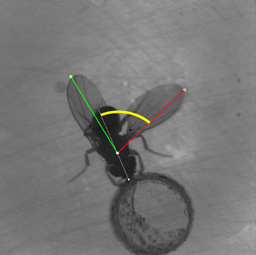
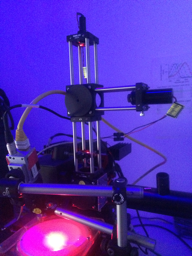
Before there was a tracking system, there was a fly walking on a styrofoam ball and a laser pointed at it. These were my first experiments switching on specific neurons with light and watching behaviour change.
- Where
- Institute of Molecular Pathology · Vienna, Austria
- When
- 2011 – 2012
- Role
- PhD project (with software engineer John Stowers)
- Tools
- Air-supported ball, machine-vision cameras, targeted laser, opto- & thermogenetics
The idea
Opto- and thermogenetic tools make it possible to switch on genetically defined neurons with light or heat. The open question was whether a laser could deliver that stimulus precisely enough, and quickly enough, to drive behaviour in a living fly.
The setup
- A fly walking in place on an air-supported styrofoam ball
- A laser aimed at the fly to activate neurons expressing opto- or thermogenetic effectors
- Machine-vision cameras recording the fly’s behaviour as neurons were switched on
Why it mattered
These experiments proved that laser activation of neurons could drive behaviour. They also showed the limits of holding a fly on a ball: it couldn’t move freely or interact with other flies. That limitation led directly to the idea behind FlyMAD: bringing laser activation to freely walking flies that can behave and interact naturally.
My contribution
This was my own PhD project, developed in collaboration with colleagues at the IMP, especially software engineer John Stowers.
Gallery